From NICU to Advocacy: Our Journey to Creating Beautiful Accessibility for All

Before our daughter Bowie was born, I honestly did not think much about accessibility.

I have always been an empathetic person, but I did not have lived experience with disability. Accessibility was something I thought of as an accommodation for a smaller group of people. I had no idea how deeply it touched everyday life until it became our reality.
Bowie’s birth was intense and unexpected. She arrived early, and her NICU stay came with a wave of frightening conversations and poor outlooks from doctors. We were told she might never breathe independently, eat on her own, walk, or talk. We were warned that her level of care could overwhelm our capacity as parents.
To me, that became motivation.
And luckily for me, Bowie is even more determined than I am.
From the very beginning, we fought together. Physical therapy. Feeding therapy. Occupational therapy. Early intervention. Endless appointments. Endless learning. Endless adaptation.
Bowie has consistently exceeded expectations and achieved far more than many people originally predicted for her future.
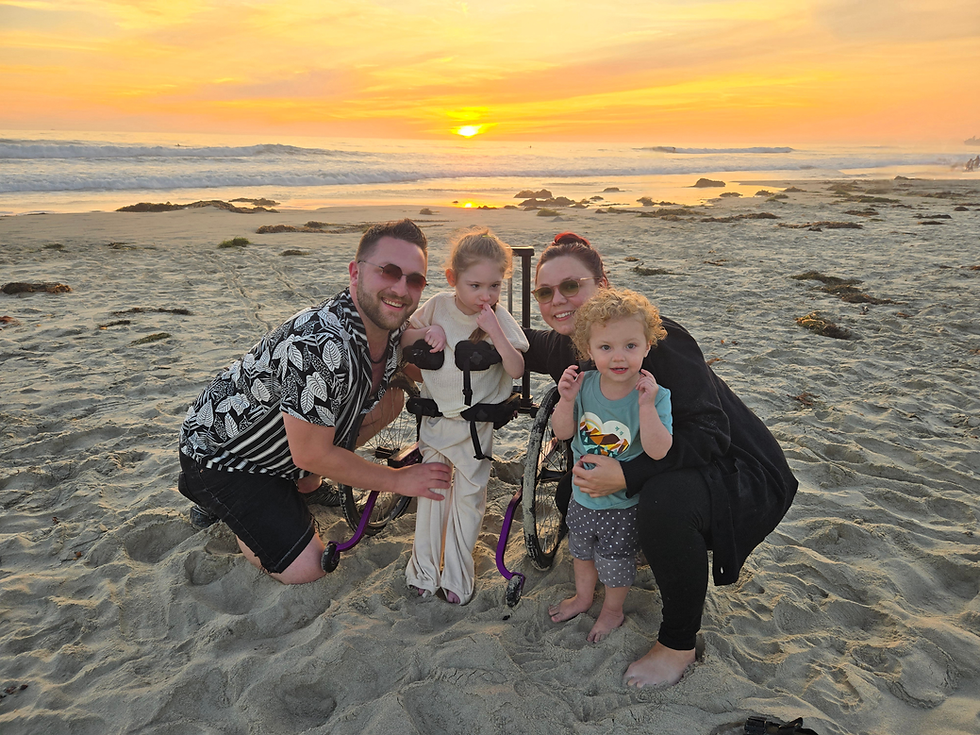
Our daughter is diagnosed with cerebral palsy and cortical visual impairment. She has taught me what it truly means to fight. But she has also taught me how unfair it is that so many individuals with disabilities and their families have to fight so hard just to exist comfortably in spaces that should already support them.
As Bowie grew, our apartment slowly transformed around her needs. Medical equipment expanded into every corner. Therapy tools filled our home. Open space became harder and harder to maintain. Because Bowie also has cortical visual impairment, clutter and visual overwhelm created additional challenges. It constantly felt like a catch-22.
Then COVID happened, and much of her therapy moved into our home through video sessions with providers. Suddenly, our living space became a therapy room, a medical environment, a sensory space, and a family home all at once.
That was one of the first moments where I realized how deeply the built environment affects quality of life.
Then came travel.

One of my greatest goals in life is to make sure Bowie experiences as much of the world as possible. She loves adventure. She loves nature. She loves exploring.
But traveling with accessibility needs can be incredibly difficult.
Equipment, mobility considerations, layouts, bathrooms, entryways, sensory needs, all of it matters. And many places labeled “ADA accessible” still create countless real-world challenges once you actually arrive. Accessibility often feels like an afterthought rather than a true standard.
Over time, we met more families, caregivers, and individuals living with their own unique disabilities and challenges. The more immersed we became in this community, the more impossible it became to ignore what we were seeing.
Once you see it, you can’t unsee it.
What struck me most was realizing how many accessibility features actually benefit everyone.
Aging parents, disabled veterans, temporary injuries, surgery recovery, strollers, visual impairments, mobility devices, chronic illness, caregivers, friends and family visiting for the holidays.
The truth is that accessibility is not about “other people.”
Most of us will experience disability, caregiving, injury, aging, or mobility challenges at some point in our lives... Either personally or through someone we love. So why do we continue building homes and environments that fail to support the realities of human life long-term?
Why do we treat accessibility like a niche specialty instead of intelligent design?
That question changed everything for me.
Long before I ever became a developer, I became an advocate.

Not because I planned to. Because I had to.
When you love someone deeply, and you continuously watch them navigate a world that was not designed with them in mind, advocacy stops feeling optional.
You start noticing everything.
The inaccessible entryways.
The “ADA accessible” spaces that still do not function well in real life. The narrow hallways.
The overwhelming environments. The lack of thoughtful design.
The way accessibility is often treated like an afterthought instead of a foundation.
At some point, advocacy became woven into every part of how I viewed the world.
And eventually, that perspective evolved into how we build.
My husband Zack has always loved real estate. We talked about investing for years, but it always felt far away. Eventually, I started sharing an idea I could not shake: truly accessible short-term rentals in beautiful destinations across the country so individuals with disabilities, caregivers, and families could experience travel together more comfortably and confidently.
Then life gave us an unexpected opportunity.
Through Zack’s chauffeur company, he connected with a man looking for transportation for his son. During conversation, they naturally started discussing Bowie, accessibility, and our dream of creating accessible short-term rentals.
That man happened to be a real estate agent.
He knew of two connected condo units owned by a power wheelchair user who had thoughtfully modified them for accessibility and operated them as short-term rentals. They were fully furnished, already functioning, and aligned perfectly with the vision we had been discussing for years.
Using a DSCR loan and years of self-education in creative financing and real estate investing, we purchased the units.
That moment changed the trajectory of our lives.
Today, Zack Alexander and I, Colë Alexander, operate our accessibility-focused short-term rentals under The Hatbox Host while continuing to expand our broader vision for accessible and inclusive development through OONAH.
You can follow our journey, advocacy, projects, and development work on Instagram at @builtbythealexanders.
As we continued learning and growing in real estate, we joined Flip Tribe, a mentorship community founded by HGTV hosts Tristyn and Kamohai Kalama of Renovation Aloha. Through that experience and the relationships we built there, we deepened our understanding of investing, development, leadership, and what it truly means to build something bigger than yourself.
Eventually, another opportunity emerged... One even bigger than we originally imagined.

Together with Zack’s lifelong best friends, Austin and Felecia, who later became our business partners, we secured 40 acres of land through another form of creative finance: seller financing. With our capital partners, we began developing a large-scale accessible and inclusive community designed around the idea that accessibility should never feel institutional, sterile, disconnected from beauty, or financially out of reach for everyday families.
Because true accessibility also includes attainability.
Because accessibility is not the opposite of luxury.
Accessibility is not the opposite of good design.
Accessibility is not limitation.
Accessibility is humanity evolving toward a better standard.
That is the heart of OONAH.
OONAH is not just about disability.
It is not just about housing. It is not just about travel.
It is about creating a network, a movement, and a new standard that honors the full spectrum of humanity.
I want people to feel seen here. I want caregivers to feel understood. I want families to feel less isolated. I want accessibility to stop feeling clinical and begin feeling integrated, elevated, modern, and normal.
I hope OONAH helps shift the narrative around accessibility so that it is no longer viewed as a specialty or an afterthought, but as something that should have always been standard.
Most of all, I hope people begin to understand that accessibility was never meant for only a small portion of society.
It was always meant for all of us.
And once you see that, you can’t unsee it. OONAH is just beginning.
Follow the journey:
Accessibility should be standard.
- Colë Alexander


Family strength we can move forward in a positive direction!