This is not my villain origin story. This is the origin story of a blessed life.

The day doctors told me my daughter had severe global brain damage and how that moment became the beginning of OONAH.

I was 27 years old when this photo was taken.
I had just undergone an emergency C-section at a hospital I'd never been to. I had never had major surgery before. I looked dazed because I was.
Earlier that day, I was laying on the couch watching Prince Harry and Meghan Markle get married. Bowie wasn't moving as much as she usually did. I had a bad feeling. I kept waiting and hoping things would improve, but eventually I decided I was done waiting.
I drove to the nearest hospital and it didn't take long for nurses to start appearing out of the walls.
I knew something was wrong, but no one was giving me answers. I was engulfed in fear. I had never even had a tooth pulled.
The next thing I knew, I was going in for a crash C-section. My clothes were stripped off my body, I was being put under general anesthesia, and I fell asleep under pandemonium and bright surgical lights.
When I woke up, I asked for my mom.
The confusion on my face in that photo speaks for itself...
I later learned I had suffered a silent placental abruption. Had I ignored my instincts and stayed on my couch, both Bowie and I likely would have died at home alone.
At that point, all I knew was that my daughter wasn't well.
She was in the NICU on another floor. I didn't get to see her for twenty-four hours.
I didn't get to hold her for an entire week. I was distraught, confused, and incredibly lost.
As the dreamlike haze of anesthesia slowly wore off, doctors and nurses began explaining things to me. Someone handed me a bottle of Zoloft and told me my daughter had HIE... Hypoxic Ischemic Encephalopathy.
I learned she had missed being eligible for a cooling blanket by one week and one pound. The treatment that might have helped reduce some of her brain injury.
I felt like I had failed.
I felt like my body had failed.
A few days later, Bowie was stable enough for an MRI.
A neurologist brought me into a quiet, private room.
Having had medical experiences with my father, I knew this wasn't a good sign.
The doctor sat me down, knelt to my level, and said the words:
"Your daughter has severe global brain damage."

The world around me glitched.
As she continued speaking, trying to explain things and comfort me, it sounded like she was talking underwater. I couldn't make out a single word she was saying.
I got up and walked away from her.
She kept talking, trying to stop me.
I turned a corner where no one else was around, or at least no one I noticed, and like a scene from a movie, I put my back against the hospital wall and slid to the floor. I let out a guttural sound that seemed to come from the depths of my soul.
The wave of anxiety and fear of the unknown consumed me.
The fluorescent lights dimmed.
The world looked like it had a sepia filter.
I don't know if I even walked with my feet after that.
I felt like I was floating.
Just a ghost wandering through a purgatory of hospital hallways.
I feared I wouldn't be enough for her.
I already believed I had failed her.
I thought maybe I should run away.
I thought my life was over.
I thought I would simply become a caregiver or a nurse.
I remember thinking I needed a vice. I needed answers.
I needed someone to tell me everything was going to be okay. Instead, everyone kept telling me that it wasn't.
Everyone kept telling me I didn't have what it takes to care for someone with such profound disabilities.
I was told I should consider a group home.
That she would need oxygen.
That she would need a feeding tube.
That she wouldn't even know I was there.
I thought about disappearing completely.
On the outside, I looked broken but calm.
Inside, my mind was swirling like a deadly tornado.
When I heard words like seizures, cerebral palsy, disability, and HIE, I thought our lives were bound for a special sort of clinical hell.
I thought I wouldn't measure up to what she needed from me.
I felt very lonely.
The PTSD embedded itself into my bones.
I thought this would break me down and put me in a dark corner.
Eventually, though, I had a come-to-Jesus moment with myself.
I told myself to get up and fight for her.
I told myself not to take these doctors' words as the entirety of my daughter's story because they didn't have a crystal ball.
Maybe things would be exactly as difficult as they described. Maybe they wouldn't. But I wasn't willing to accept any future without a fight.
Luckily, Bowie is even stronger than I am.
She fought harder than I could have ever asked a four-pound baby to fight.
And then something happened.
She came home.
At five pounds.
Breastfeeding.
Breathing independently.
After we had been told she would never eat without a feeding tube or breathe without oxygen tanks.
She came home on four medications and was weaned off all of them by her first birthday. She grew, she smiled, she enjoyed her life, she loved to snuggle, she loved jazz music and movies and pretty lights. She loved connecting with the people she loved.
This girl has always, always loved the beach and anything tropical.
I remember taking her to the beach after her month-long NICU stay and seeing her so clearly in her happy place. And honestly?
My daughter is quite possibly one of the happiest people I have ever met.
I remember standing in Walgreens once and overhearing a cashier tell another employee that there was something special about her. That she had a special light. They didn't know her diagnosis. At that age, they wouldn't have known.
They just saw HER. They saw her light.
And slowly, I began to realize something.
The tragedy wasn't Bowie.
The problem wasn't my daughter.
The problem was the world around her.

As she got older and accumulated mobility devices, standers, bath chairs, and equipment, our tiny apartment no longer worked for our family.
Travel became harder.
Changing her privately became harder.
I noticed people parking in accessible spots because they simply didn't care.
I noticed schools repeatedly treating disabled students differently.
I remember an IEP meeting where a teacher referred to neurotypical children of the same age as "the big kids."
I stopped her... I asked: "What makes those students the big kids? They are the same age... is it their lack of disability?"
I could see the shame on her face.
Because that's when it became crystal clear.
The world wasn't built with my daughter in mind.
I have never gone to a school that truly treated disabled students as equal.
I have spent years fighting, I refuse to place Bowie in environments where she is regarded as smaller simply because she is disabled.
Bowie has more to teach the world than that.
Over time, I began to understand the gravity of disability and its impact on everyone's lives.
Because accessibility isn't niche.
At minimum, it's the curb-cut effect.
More honestly? It's a necessity.
Every single one of us will become disabled, love someone who is disabled, care for someone who is disabled, or simply grow old.
And yet we've built a world that often acts surprised by that reality.
I noticed how unfair it was.
And my vice became fighting for a better world.
To make sure other people don't feel the same loneliness.
To make sure our children and loved ones of all different walks of life can feel accepted and comfortable living in this world. Seen, heard, and included.
If I could go back and sit beside that terrified twenty-seven-year-old version of myself in the hospital bed, I would tell her this:
Have some grace for yourself.
This is not your villain origin story. This is the origin story of a blessed life.
It feels scary because it is unknown.
But it's time to pull yourself up, with grace, and pioneer a new life.
Don't lean into the sadness of what could have been.
Grieve it, yes.
But make space for what could be and what will be.
A profound love. A spiritual connection with your daughter who needs you and loves you more than you could possibly fathom.
Do not become a victim of circumstances.
Be your own hero.
Lean into the strength that is love.
Breathe life into something that feels like a doomed end.
Because it is only the beginning of something so special that I still struggle to put it into words.
Do it scared. But do it with love.
We're building accessible communities because we know what it's like to feel overlooked.
We know what it's like to be told your life is going to be smaller.
And we know something else now too:
Disability isn't the end of a story. It's just a different one. And sometimes, if you're willing to let it, it becomes the story that changes everything.
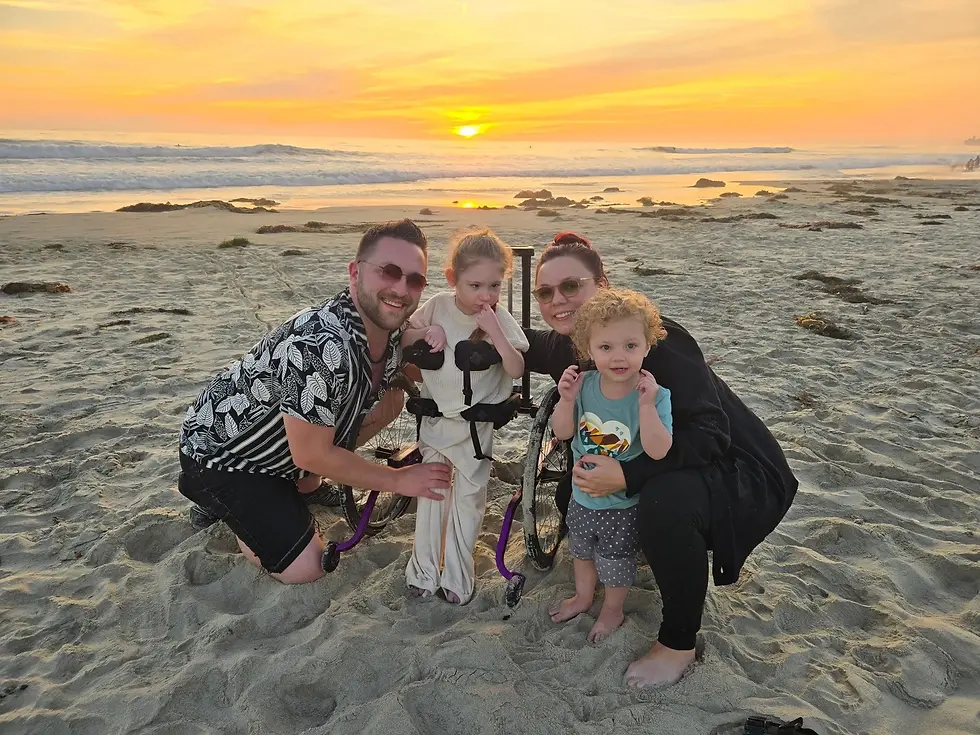
And everyone deserves spaces that assume possibility, dignity, belonging, and love from the very beginning.
Colë Alexander
Founder, OONAH


Comments